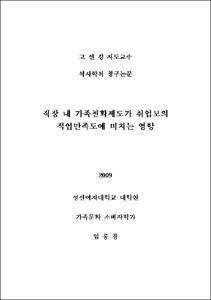
직장 내 가족친화제도가 취업모의 직업만족도에 미치는 영향
- Abstract
- 본 연구는 가족친화정책이 직업만족도에 미치는 영향을 파악하기 위해 영유아자녀가 있는 취업모의 개인·가족 변인, 직업관련 변인, 가족친화제도 이용 변인에 따른 직업만족도를 분석하였다. 이를 위해서 개인·가족 변인 변인으로는 연령, 학력, 개인소득, 가정수입, 주택소유, 가족구성원, 막내자녀연령을 직업관련 변인으로는 직종, 주당근로시간, 근속기간, 직위, 근로형태, 고용형태, 총 근로자수 등을 알아보았다.
또한 가족친화제도 이용에 관한 변수로는 근무제, 휴가제, 수당제, 직장보육시설을 알아보고 이러한 변인들이 직업만족도에 어떠한 영향을 미치며 어떠한 관계가 있는지 알아보았다.
본 연구의 대상은 미취학 자녀가 있는 취업모 237명을 대상으로 질문지를 이용하여 조사하였으며, 제작된 질문지는 예비조사 후 수정, 보완하여 본 조사를 실시하였다. 회수된 질문지에 대한 자료 분석은 기술통계 분석 외에 T-test와 ANOVA, 교차분석, 회귀분석을 이용하였다.
주요 연구 결과는 다음과 같다.
첫째, 기업들은 법적으로 의무화되어 있는 가족친화제도만을 시행하고 있으며, 근로자들 또한 의무화된 제도만을 사용하고 있는 실정이었다.
둘째, 근무제, 수당제, 휴직제, 직장보육시설제도의 이용실태를 조사한 결과, 개인·가족특성에서는 개인소득이, 직업특성에서는 근속기간, 근로형태, 고용형태, 총 근로자수가 공통적으로 영향을 미치는 변수였다. 즉, 기업의 규모가 클수록 가족친화제도가 의무화되어 있어 근로자들의 접근성이 용이하였다. 상기한 네 가지 제도 중 직장보육시설제도에서만 연령에 유의미한 차이가 나타났다. 25∼30세 주된 여성들이 이 제도를 가장 많이 이용하는 것으로 나타나, 이 연령대의 여성들에게 자녀양육에 도움이 된 것임을 알 수 있다. 또한 직장보육시설제도로 인해 양육의 문제가 일정 부분 해결된다면 일-가정 균형에 긍정적인 영향을 미칠 것으로 예상된다.
셋째, 가족친화제도의 조직문화에서 이용용이성은 앞서 언급한바와 같이 법적으로 의무화된 기업, 전일제·정규직 등의 안정성이 보장되는 대기업일수록 이용용이성이 긍정적이었다. 반면 인사상의 불이익이 존재할 경우, 인사에 가장 민감한 시기인 31세 이상, 3년 이상 일한 근로자들이 해당되었다.
넷째, 조사대상자의 개인·가족·직업특성에 따른 직업만족도에 어떠한 차이가 있는지 조사한 결과, 개인소득, 가정수입, 주택소유 등 경제적인 면이 두드러졌고 직종에 있어서는 전문직 취업모들이 직업만족도가 높았다.
다섯째, 가족친화제도 이용에 따른 직업만족도에서는 휴직제와 수당제가 직업만족도에 영향을 미쳤다. 즉, 금전적인 부분에 도움이 될 수 있는 제도들이 직업만족도에도 긍정적인 효과를 미치는 것을 시사한다.
여섯째, 가족친화제도 이용용이성에 따른 직업만족도를 보면 이용촉진, 인사상의 불이익, 상사신경쓰기, 동료신경쓰기, 이용용이성은 직업만족도와 상관관계가 낮은 것으로 나타났다.
마지막으로, 개인·가족·직업특성변인, 가족친화제도 이용을 투입하여 위계적으로 회귀 분석한 결과, 경제적인 안정감과 휴직제도 외에도 가장 큰 실행 변인은 가족친화제도의 이용용이성이었다.|This research analyzed the job satisfaction following individual/family variables, employment-related variables, and utilization variables of family-friendly corporate policies of employed mothers with young children to understand the effect of the influence family-friendly corporate policies on job satisfaction. In order to do this, age, education level, personal income, family income, home ownership, family makeup, and age of the youngest child were examined as individual/family variables while the type of occupation, weekly working hours, longevity of services, employment position, work status, employment status, and total number of employees were examined as vocation related variables.
Additionally, systems for work, leave, and benefit along with corporate-sponsored child care centers were examined as variables regarding the utilization of family-friendly corporate policies, and such variables were studied to see what influences they had and how they were related to the job satisfaction.
This research surveyed, using questionnaires, targeting 237 employed mothers with preschool children while the actual survey was conducted after the produced questionnaires were modified and supplemented following a pre-survey. The data analysis on the collected questionnaires was done through the T-test, ANOVA, cross analysis, and regression analysis including descriptive analysis.
The main research results are as follows.
First, the reality was that companies performed only legally mandatory family-friendly corporate policies and even workers used only obligatory ones.
Second, the result of examining the actual utilization situation of work, leave, and benefit systems along with a system of corporate-sponsored child care centers showed that personal income in regards to individual/family characteristics, and longevity of service, work status, employment status, and total number of employees for vocational characteristics were the commonly effecting variables. That is, the approaching character of workers was simple because the bigger the company’s scale, the more family-friendly corporate policies were mandatory. Among the four policies described in the above, a significant difference on age was seen only in a system of corporate-sponsored child care centers. By showing the fact that women aged 25~30 used this policy most frequently, it was deduced that it supported child upbringing for women in this age group. Moreover, if the problem of childcare is partly resolved through a system of corporate-sponsored child care centers, it is anticipated that the work-home balance will receive positive influences.
Third, the ease of use in the organizational culture of family-friendly corporate policies was more positive the more a company was a firm which is legally obligatory or it is a conglomerate where safety such as full-time or regular employment is secured as mentioned previously. On the other hand, if disadvantages exist, they are applicable to over 31years old workers, the most sensitive periods to personnel and those who have worked over 3 years.
Fourth, the result of studying the differences in the job satisfaction according to individual/family/vocational characteristics of survey targets, economic aspects such as personal income, family income, home ownership, and more were seen as outstanding while for the type of occupation, the job satisfaction of employed mothers with professional jobs was high. Fifth, in the job satisfaction along the utilization of family-friendly corporate policies, systems of leave and benefit gave influences on the job satisfaction. Namely, it suggests that policies able to help the financial aspects will have a positive influence on the job satisfaction.
Sixth, when seeing the job satisfaction according to the ease of the utility of family-friendly corporate policies; acceleration of use, disadvantages on personnel affairs, caring about superiors, caring about coworkers, and the ease of use appeared to have low correlation with the job satisfaction.
Lastly, the result of hierarchically regression-analyzing by inputting individual/family/vocational characteristics variables and the utility of family-friendly corporate policies, the biggest execution variable, excluding the sense of economic safety and the leave system, was the ease regarding the utility of family-friendly corporate policies.
- Issued Date
- 2009
- Awarded Date
- 2009-02
- Type
- Dissertation
- Alternative Author(s)
- Lim, Jung kyung
- Affiliation
- 성신여자대학교 대학원
- Department
- 일반대학원 가족문화소비자과
- Advisor
- 고선강
- Table Of Contents
- Ⅰ. 연구의 필요성 및 목적 = 1
Ⅱ. 선행연구 고찰 = 4
1. 가족친화제도 = 4
1) 가족친화제도의 개념 = 4
2. 직업만족도 = 6
1) 직업만족도의 개념 = 6
2) 직업만족도에 영향을 미치는 변인 = 9
Ⅲ. 연구 방법 = 19
1. 연구 모형 및 연구 문제 = 19
2. 연구 대상 및 측정 도구 = 20
3. 분석 방법 = 22
4. 조사대상자의 일반적 특성 = 23
Ⅳ. 연구결과 및 해석 = 26
1. 개인·가족, 직업특성에 따른 가족친화제도 이용 및 이용용이성 = 26
1) 가족친화제도 실태 = 26
2) 개인, 가족, 직업 특성에 따른 가족친화제도 이용 = 29
3) 개인, 가족, 직업 특성에 따른 가족친화제도 이용용이성 = 42
2. 개인, 가족, 직업특성에 따른 직업만족도 = 50
1) 직업만족도 실태 = 50
2) 개인, 가족, 직업 특성에 따른 직업만족도 = 51
3. 개인, 가족, 직업특성, 가족친화제도가 직업만족도에 미치는 영향 = 54
1) 가족친화제도 이용 및 이용용이성과 직업 만족도 = 54
4. 개인·가족 직업특성변인, 가족친화제도이용이 직업만족도에 미치는 영향 = 56
Ⅴ. 결론 및 제언 = 60
참고문헌 = 65
Abstract = 73
부록 1 질문지 = 77
부록 2 개인·가족·직업특성,가족친화제도이용이 직업만족도에 미치는 공성선 진단 = 82
- Degree
- Master
- Publisher
- 성신여자대학교 대학원
- 파일 목록
-
-
Download
 직장 내 가족친화제도가 취업모의 직업만족도에 미치는 영향.pdf
기타 데이터 / 4.33 MB / Adobe PDF
직장 내 가족친화제도가 취업모의 직업만족도에 미치는 영향.pdf
기타 데이터 / 4.33 MB / Adobe PDF
-
Items in Repository are protected by copyright, with all rights reserved, unless otherwise indicated.