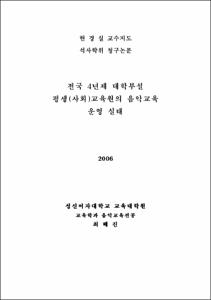
전국 4년제 대학부설 평생(사회)교육원의 음악교육 운영 실태
- Alternative Title
- The state of operating music education at Academy of Continuing Education, housed on a university across the country
- Abstract
- 본 연구에서는 대학 부설 평생(사회)교육원의 중요성을 새롭게 인식하고, 대학 부설 평생교육원의 음악 프로그램 운영 실태를 조사하고 비교․분석함으로써 좀 더 나은 방향으로 음악 프로그램 개발 방향을 모색하는 것에 있다.
이를 위하여 각 대학의 평생(사회)교육원 인터넷 홈페이지의 음악관련 프로그램 자료만을 토대로 분석하였으며, 분석한 결과는 다음과 같다.
첫째,한국교육협의회의 내용을 토대로 전국 4년제 대학교를 살펴보면 총 215개교인데, 그 중 평생(사회)교육원이 설치되어 있는 학교는 163개교, 음악교육 프로그램이 개설되어 있는 학교를 살펴보면 112개교이다.
둘째, 음악 프로그램을 교육목적과 내용에 따라 학점은행제, 일반(실기․이론)과정, 전문․지도자 과정으로 나누어 보았다. 각 지역 분포도에 따른 학점은행제, 일반(실기․이론)과정, 전문․지도자과정을 비교․분석한 결과 일반(실기․이론)과정, 전문․지도자 과정, 학점은행제 순으로 개설되고 있음을 알 수 있다. 학점은행제, 전문․지도자 과정, 일반(실기․이론)과정의 강좌를 모두 개설한 평생(사회)교육원은 소수에 불과하며, 대부분 전문․지도자 과정 또는, 일반(실기․이론)과정만 개설하였다.
셋째, 각 과정에서 강좌의 종류와 그에 따른 세부 강좌로 나누어 통계 및 교육과정을 분석 한 결과, 일반(실기․이론)과정에서 서양음악은 관현악 관련, 전통음악은 판소리의 개설 비율이 높았다. 전문․지도자 과정에서 서양음악은 피아노 관련, 전통음악은 국악실기 지도사와 아동 국악 지도사가 학점은행제에서는 피아노 전공의 개설 비율이 높았다.
전반적으로 특정 분야의 기능을 연마하거나 흥미를 유발하기 위한 실기 위주의 과정으로 편성하고 있어 음악 미적 체험을 통해 삶의 질을 높이고자 하는 평생 음악교육의 목적과는 부합되지 못하고 있다고 할 수 있다.
따라서 각 연령층과 성별, 학력별, 직업별, 수준별 등에 따른 평생교육 욕구를 충족시킬 수 있는 프로그램, 직장인과 전문인을 위한 프로그램 등의 신설과 확대가 필요하며, 특히 성인과 그 지역의 특성을 고려하여 정보화, 세계화 시대에 맞는 다양하고 전략적인 수요자 중심의 프로그램 개발이 필요하다.|In this study, one of the purpose at this work is to recognize the importance of an Academy of Continuing Education, housed on a university, and another is finding the better ways of developing music program by investigating the condition of operating music education at the Academy of Continuing Education, housed on the university and comparing and analyzing it.
For this study, I analyzed the data on the basis of educational program, which I researched on-line, related to music from the webpage of each Academy of Continuing Education. And following results are indicating my analysis.
First, there are 215 universities in this country on the basis of the data of Korea Council for University Education. Among them, only 163 universities have the Academy of Continuing Education and only 112 universities operate the program of music education.
Second, I classified the music program as an Academic credit bank system, regular(theoretical & practical) course, specialist & leadership course according to educational purpose and contents.
As a result of the analysis that I compared and analyzed Academic credit bank system, regular(theoretical & practical) course, specialist & leadership course according to each local distribution, I could know each ACE opened the music program followed by regular(theoretical & practical) course, specialist & leadership course, Academic credit bank system. The Academy of Continuing Education which opens all music program such like Academic credit bank system, regular(theoretical & practical) course, specialist & leadership course is a few, most of the ACE opens only regular(theoretical & practical) course or specialist & leadership course.
Third, as a result of the analysis that analyzed the statistics and education course classified by the kinds of each course and sub-course , the orchestration is the biggest portion of the western music and the pansori is the biggest portion of the traditional music in regular(theoretical & practical) course. Piano related course is the biggest portion of the western music, the traditional music leadership course and the traditional leadership course for children are the biggest portion of the traditional music in specialist & leadership course. In Academic credit bank system, the piano related course is the biggest portion of the western music.
Because most of the Academy of Continuing Education organizes their music education courses as a practice-driven course to train the skill at certain field of music or to take an interest in music, so I may say that they are not matched to the origin purpose of the Academy of Continuing Education that make someone improve their quality of life with an aesthetic experience of music.
Therefore, we need to establish new program and expand the variety of the program for employees and specialist to make them satisfied with their need of continuing education according to level of each age group, gender, scholarship and job. Especially, we need to develop the various and strategic customer-driven program, regarding the adult and regional feature, that is adequate to info and global age.
- Issued Date
- 2006
- Awarded Date
- 2006-02
- Type
- Dissertation
- Alternative Author(s)
- Choi, Hye-Jin
- Affiliation
- 성신여자대학교 교육대학원
- Department
- 교육대학원 음악교육
- Advisor
- 현경실
- Table Of Contents
- Ⅰ. 서 론 = 1
1. 연구의 필요성 = 1
2. 연구의 목적 = 3
3. 연구의 방법 = 4
4. 연구의 제한점 = 4
Ⅱ. 이론적 배경 = 5
1. 평생교육의 의의 = 5
2. 대학에서의 평생교육 = 8
1) 대학평생교육의 개념 및 필요성 = 8
2) 대학평생교육의 발생배경 = 10
3) 대학평생기관의 평생과정 유형 = 11
4) 우리나라의 학점은행제 = 13
3. 평생교육으로서의 음악교육 = 15
1) 평생교육으로서의 음악교육 발생배경 및 형성과정 = 15
2) 평생교육으로서의 음악교육 중요성 = 16
4. 선행연구 = 17
Ⅲ. 연구 방법 = 20
1. 연구 대상 및 기간 = 20
2. 연구 도구 = 20
3. 연구 방법 및 절차 = 21
Ⅳ. 전국 4년제 대학 부설 평생(사회)교육원의 음악교육 운영 실태 조사 = 22
1. 전국 4년제 대학 부설 평생(사회)교육원의 음악교육 프로그램 설치학교 = 22
2. 전국 4년제 대학 부설 평생(사회)교육원의 음악 프로그램 분석 = 24
1) 대학 부설 평생(사회)교육원의 음악 교육과정 유형과 현황 = 24
2) 대학 부설 평생(사회)교육원 음악관련 강좌 = 25
3) 교육기간 = 46
4) 교육자격 = 47
5) 수강인원 = 50
6) 수강료 = 52
7) 강사진 = 53
Ⅴ. 결론 및 제언 = 54
참고문헌 = 58
ABSTRACT = 60
부록 1 = 63
- Degree
- Master
- Publisher
- 성신여자대학교
- 파일 목록
-
-
Download
 전국 4년제 대학부설 평생(사회)교육원의 음악교육 운영 실태.pdf
기타 데이터 / 3.02 MB / Adobe PDF
전국 4년제 대학부설 평생(사회)교육원의 음악교육 운영 실태.pdf
기타 데이터 / 3.02 MB / Adobe PDF
-
Items in Repository are protected by copyright, with all rights reserved, unless otherwise indicated.