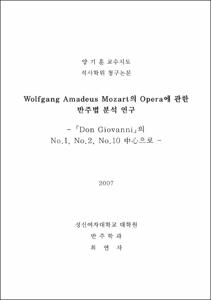
Wolfgang Amadeus Mozart의 Opera에 관한 반주법 분석 연구
- Alternative Title
- A Study on the Accompaniment of Opera Don Giovanni by W.A. Mozart
- Abstract
- This paper examines the opera Don Giovanni composed by W. A. Mozart, who made great contribution to the development of classic opera in the 18th century.
Mozart's opera is highly praised for excellent harmony between drama and music. It is particularly notable that he makes dynamic and effective use of vocal parts, the musical elements included in orchestral accompaniment such as tempo, harmony, tonality, rhythm, melody, instruments as well as various musical forms such as recitativo, aria, and ensemble, to achieve a strong sense of unity between the drama and music. Composed after Mozart's music has matured, it is of high musical value displaying the unique and developed characteristics of Mozart's operas as well as the mixed characteristics of comedy and melodrama.
This paper focuses on Don Giovanni, which shows the uniqueness of Mozart's opera better than other operas based on such harmony between drama. This opera was composed in 1787 when Mozart wrote the music to Lorenzo da Ponte's script. Although it is a two-act opera buffa, it is actually classified as dramma giocoso, a mixture of buffa and seria elements, containing not only comedy typically shown in opera buffas but also melodrama and supernatural elements.
The first part of the paper summarizes Mozart's life, his operas and the characteristics of his music. It also covers the overview and synopsis of Don Giovanni. The analysis of the opera presents the original lyrics and brief translations. For in-depth analysis of the musical pieces, the general characteristics of each piece are examined and the structures are organized into a table. Based on the structures, accompaniment techniques are examined around the relationship between the vocal part and the accompaniment part with a greater focus on drama description. Musical score examples are also provided for further understanding. It is particularly important to note that the music scores for opera accompaniment, which is designed for orchestra, are edited for piano accompaniment, and the image of the music can change depending on the editor. Thus, when necessary, the scores of Berä nreiter and Ricordi are compared based on the orchestral score to provide ideal accompaniment for maximum drama effect.
The last part of this paper sums up the main characteristics of Mozart's opera based on the above analyses, and also draws attention to important points to consider for piano accompaniment.
This study gives an opportunity to understand Mozart's opera on a deeper level, and further clarifies the role of the piano accompanist with emphasis on confidence in musical expression and interpretation based on deep understanding and knowledge of the music, as well as a close partnership between the singer and the accompanist.
- Issued Date
- 2007
- Awarded Date
- 2007-08
- Type
- Dissertation
- Alternative Author(s)
- Choi, Yeon-Ja
- Affiliation
- 성신여자대학교 대학원
- Department
- 일반대학원 반주학과
- Advisor
- 양기훈
- Table Of Contents
- Ⅰ. 서론 = 1
Ⅱ. 모차르트(Wolfgang Amadeus Mozart,1756-1791)의 생애 및 장르별 오페라 특징 = 3
1. 모차르트의 생애 = 3
2. 모차르트의 오페라의 장르별 음악 특징 = 10
(1) 오페라 세리아 = 10
(2) 오페라 부파 = 14
(3) 징슈필 = 18
Ⅲ. 모차르트의 Opera분석 연구 = 22
1.작품 개요 = 22
2.작품 내용 = 24
3. 작품 분석 = 26
(1) No. 1 Introduzione Notte e giorno faticar = 26
1) 대본의 원문 및 번역 = 26
2) 악곡 분석 = 28
(2) No.2 Recitativo e duetto Fuggi, crudele, fuggi! = 50
1) 대본의 원문 및 번역 = 50
2) 악곡 분석 = 52
(3) No.10 Recitativo e Aria Or sai chi l'onore = 71
1) 대본의 원문 및 번역 = 71
2) 악곡 분석 = 73
Ⅳ. 결론 = 83
참고 문헌 = 87
ABSTRACT = 90
- Degree
- Master
- Publisher
- 성신여자대학교 대학원
- 파일 목록
-
-
Download
 Wolfgang Amadeus Mozart의 Opera에 관한 반주법 분석 연구.pdf
기타 데이터 / 9.58 MB / Adobe PDF
Wolfgang Amadeus Mozart의 Opera에 관한 반주법 분석 연구.pdf
기타 데이터 / 9.58 MB / Adobe PDF
-
Items in Repository are protected by copyright, with all rights reserved, unless otherwise indicated.