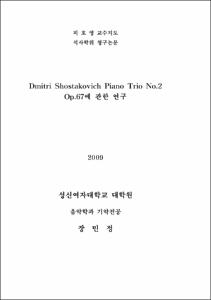
Dmitri Shostakovich Piano Trio No.2 Op.67에 관한 연구
- Abstract
- 20세기 러시아 작곡가 쇼스타코비치(D. Shostakovich, 1906-1975)는 혁명, 제 2차 세계대전, 스탈린의 정권 등 러시아의 시대적인 상황을 통해 그의 작품 활동에 있어서 많은 영향을 받았다.
본 논문은 쇼스타코비치의 피아노 트리오 작품 중에서 피아노 트리오 No.2 Op.67의 통해 사회적 그의 삶과 곡의 음악적 특징을 분석하고자 한다. 우선 실내악의 역사를 통해 피아노 트리오의 발전과 쇼스타코비치의 생애와 시대적 상황에 따른 음악적 경향과 그의 두 개의 피아노 트리오의 작품에서 나타나는 전반적인 음악적 특징을 알아보고, 그 중 사회주의 리얼리즘에 영향을 받은 쇼스타코비치 피아노 트리오 No.2 Op.67의 작품을 각 악장별로 분석하여, 곡의 형식과 중심 주제를 알아보고 음악적 특징을 통해 그의 음악을 이해하고 연주에 도움이 되고자 하는 목적이 있다.
쇼스타코비치의 초기의 유일한 실내악 곡인 피아노 트리오 No.1 Op.8을 살펴보면, 제 1차 세계대전이 일어난 후 쓰여 진 곡으로, 신고전주의의 영향을 많이 받았다. 본 연구자가 이 곡을 연주 해 본 바, 단일악장의 소나타 형식으로, 반음계적 성향으로 조성이 이동되어 매우 복잡한 조성을 갖고 있으며 음정관계의 반복으로 음렬적인 성격이 나타나며, 반음을 이용하여 리듬 변화, 옥타브를 사용하여 주제를 만들어 간다. 반음계를 사용하여 긴 프레이즈로 연결하고 아무런 제시 없이 갑자기 종지를 하면서 전혀 다른 악장이 새롭게 시작하는 부분들이 많으며, 전체적인 리듬은 바로크의 리듬 8분음표, 16분음표를 음형을 많이 사용하였다.
피아노 트리오 No.2 Op.67 는 제 2차 세계대전 때, 사회주의 리얼리즘에 영향을 받아 음렬주의의 배제하지 않고 반음계를 사용하거나 러시아의 민요적 요소를 사용하여 곡에 나타내었다. 전통적인 고전형식의 소나타 형식으로 4악장으로 구성되어있으며, 각 악장 마다 그 특징이 나타난다. 제 1악장은 조성과 박자, 빠르기 형식에 의한 소나타 형식으로 주제선율을 대위적으로 모방하여 나타나며. 제 2악장은 자유로운 겹 세도막 형식으로 구성되었으며, 1악장과 마찬가지로 대위적인 주제선율이 모방되며, 동행진행을 사용하여 악절 간을 연결하였다. 제 3악장은 느린 악장의 변주곡 형태로 8개의 화음을 가지고 있는 주제가 피아노에서 시작하여 연속으로 6차례 나타나는 동안 바이올린과 첼로에 의해 주제가 모방되어 나타난다. 제 4악장은 론도형식으로 되어있으며, 러시아의 민요적 요소로 각각의 주제가 반음계적 비화성음을 가지고 있는 동기를 통해 변형 발전되어 곡에 다양하게 사용되며, 증 2도, 증4도, 장7도, 단9도의 음정이 나타난다.
이렇듯 그의 두 피아노 트리오 작품을 통해서도 소나타 구조와 반음, 반음계적 음렬을 사용하는 공통점도 있지만, 조성, 음렬의 나열, 악절과 악절이 연결되어지는 부분들의 작곡기법의 차이점을 통해 쇼스타코비치는 그의 작품 활동에 있어 시대적인 영향을 많이 받았음을 알 수 있다.
본 연구자는 이 논문을 통해 사회적 리얼리즘에 영향을 받은 피아노 트리오 No.2 Op.67 작품을 통해 각 악장을 분석하여 주제의 발전과 구성요소, 음악적 기법에 대해서 알아보고자 한다.
| D. Shostakovich(1906-1975), a Russian composer of the 20th century, lived through revolution, Bolshevik revolution of 1917, World War II, Stalin regime, so he reflected all these upheaval in his art work.
This study is designed to analyse a musical feature melted in his contemporary life with special reference to No.2 Op. 67 of Piano Trio. At first, I tried to examine Shostakovich's musical feature gone through the contemporary age with special reference to brief survey of Piano Trio in the history of chamber concert relating to his life, upon which I want draw out overall character of his Piano trilogy. Piano trio No.2 Op. 67 as a typical example of his music was analysed by each chapter, music type, and main theme to get into better understanding & performance of his music world.
A unique chamber music No. 1 Op.8 played in early stage of his career was composed right after The First World War, so it strongly reflected Neo-Classicism. As I played this music, this was found as one chapter sonata, half gamut with composite composition, competitive interval, rhythmical change by semitone, and making a theme by means of octave. He connected each chapter with long phrase by semitone, but at a certain point it stopped suddenly without notice to start a new part. In all these procedure, he usually used them to make baroque rhythm with eighth note, sixteenth note respectively.
Piano Trio No.2 Op.67 seen during the World War II and influenced by Socialistic realism is showing that it reflected a Russian folk with semi-tones including serialism. This music consisted of 4 chapters in traditional classic sonatas, and each one have their own feature. The first chapter is a sonata featured by composition, time, and speed, and it imitates a theme in counterpoint. The second chapter consisted of double three section types, as it is seen in the first chapter, it is imitating a theme with counterpoint, connected each passages by going together. The third chapter is a variation of slow chapter, in which a theme with 8 different chords started with piano, and during the 6 consecutive repetitions, violin & cellos back up the main theme. In the fourth chapter, a rondo type was applied to reflect Russian folk, in which each theme was depicted in many different variation by means of non-harmonic semitones, and in it there are minor3, from do to fa#, major 7, and minor 9.
As we see here, his art work preferred to use sonata structure & semitone, chromatic scale series, but he differentiated composition, arrange of sound series, inter-passages in his composing technique. In this sense, we know that his music world is not free from the contemporary atmosphere.
I through this study, tried to analysed Piano Trio No.2 Op.67 of Shostakovich, and came to end that it was totally influenced by social realism of contemporary Russia. Upon such a analysis, I interpreted his musical technique, compositional elements, and development of theme in each chapter.
- Issued Date
- 2009
- Awarded Date
- 2009-08
- Type
- Dissertation
- 파일 목록
-
-
Download
 Dmitri Shostakovich Piano Trio No.2 Op.67에 관한 연구.pdf
기타 데이터 / 15.63 MB / Adobe PDF
Dmitri Shostakovich Piano Trio No.2 Op.67에 관한 연구.pdf
기타 데이터 / 15.63 MB / Adobe PDF
-
Items in Repository are protected by copyright, with all rights reserved, unless otherwise indicated.