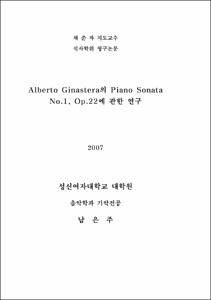
Alberto Ginastera의 Piano Sonata No.1, Op.22에 관한 연구
- Alternative Title
- A Study on the Alberto Ginastera's Piano Sonata No.1, Op.22
- Abstract
- 알베르토 히나스테라(Alberto Ginastera, 1916~1983)는 20세기 아르헨티나를 대표하는 작곡가로서 아르헨티나 뿐만 아니라 미국과 유럽 등지에서도 음악활동을 펼쳤다.
그의 작품 활동 시기는 ‘객관적 민족주의(objective nationalism : 1937~1947), 주관적 민족주의(subjective nationalism : 1947~1957), 신표현주의(neo-expressionism : 1958~1983)' 로 나누어 볼 수 있다. ‘객관적 민족주의’는 아르헨티나의 민속적인 요소들을 명확하게 나타내며, ‘주관적 민족주의’는 민속적인 요소를 상징적으로 나타낸다. ‘신표현주의’는 작곡가의 주관적인 느낌과 현대적 기법을 나타낸다.
본 논문에서 분석한 『Piano Sonata No.1, Op.22』는 총 4개의 악장으로 구성되어 있으며, '주관적 민족주의'에 속하는 작품으로 아르헨티나의 민속적인 요소가 상징적으로 표현된 작품이다.
제 1악장은 전통적인 소나타 형식으로서 제시부, 발전부, 재현부, 종결부로 이루어졌으며, 민속적인 성격을 가지는 말람보(malambo) 리듬, 당김음, 복조성, 잦은 변박, 도약하는 선율과 하행하는 선율 등의 요소를 가지고 진행되고 있다. 제 2악장은 스케르초풍의 론도 소나타 형식으로서 12음기법을 처음으로 사용하였다. 제 3악장은 느린 악장으로서 유일하게 민속적인 요소가 나타나지 않은 악장이다. 제 4악장은 말람보 리듬과 오스티나토를 두드러지게 사용함으로써 민속 음악적인 요소를 강조하고 있다. 전체적으로 아르헨티나 민속 음악의 요소들과 현대적인 기법이 적절하게 조화된 작품이라고 볼 수 있다.|Alberto Ginastera(1916~1983) who is one of the representative composers of twenty century Argentine music had done a lot of musical activities in not only Argentina but also United States and Europe.
His compositional activities can be subdivided into three periods :'objective nationalism(1937~1947), subjective nationalism (1947~1957) and neo-expressionism(1958~1983). Objective nationalism expresses Argentine folk aspects directly but subjective nationalism does it symbolically. Neo-expressionism showes subjective feeling and contemporary technique.
In this thesis, I have analyzed piano sonata no.1, op.22. As a piece representing subjective nationalism, it is composed of four movements and shows Argentic folk aspects in symbolitic manner.
The first movement take the form of traditional sonata form which consits of exposition, development, recapitulation and closing section. It makes use of malambo rhythm, syncopation, bitonality, frequent meter change, jumping or descending melody which represent argentine folk nature. The second movement take the form of rondo sonata in Scherzo mood and use twelve-tone technique for the time. Exceptionally, the slow-tempo third movement does not show folk aspect. In fourth movement, he emphasizes folk music nature with massive use of malambo rhythm and ostinato.
In perspective, this piece can be regarded as well-balanced one between both Argentine folk aspects and contemporary techiques.
- Issued Date
- 2007
- Awarded Date
- 2007-08
- Type
- Dissertation
- Alternative Author(s)
- Nam, Eun-Ju
- Affiliation
- 성신여자대학교 일반대학원
- Department
- 일반대학원 음악학과
- Advisor
- 채준자
- Table Of Contents
- Ⅰ. 서론 = 1
Ⅱ. 히나스테라의 생애 = 3
Ⅲ. 히나스테라의 작품양식 = 10
Ⅳ. 히나스테라의 『Piano Sonata No.1, Op.22』분석 = 16
1) 제 1악장 : Allegro marcato = 16
2) 제 2악장 : Presto misterioso = 34
3) 제 3악장 : Adagio molto appassionato = 51
4) 제 4악장 : Ruvido ed ostinato = 62
Ⅴ. 결론 = 79
참고문헌 = 81
ABSTRACT = 84
- Degree
- Master
- Publisher
- 성신여자대학교 일반대학원
- 파일 목록
-
-
Download
 Alberto Ginastera의 Piano Sonata No.1, Op.22에 관한 연구.pdf
기타 데이터 / 7.03 MB / Adobe PDF
Alberto Ginastera의 Piano Sonata No.1, Op.22에 관한 연구.pdf
기타 데이터 / 7.03 MB / Adobe PDF
-
Items in Repository are protected by copyright, with all rights reserved, unless otherwise indicated.