집행임원제도에 관한 법적 연구
- Alternative Title
- A Legal Study on Executive Officer System
- Abstract
- IMF 체제 이후 기업지배구조 논의와 함께 기업경영의 투명성과 효율성 및 국제경쟁력 강화는 가장 큰 화두가 되었고, 이를 위해 수차례의 상법 개정이 이루어져 미국식의 사외이사제도, 감사위원회제도 등이 도입되었다. 그러나 정작 이사회 구조를 개선하기 위한 하나의 주축인 집행임원제도를 도입하지 않았고, 이에 따라 여전히 집행부와 이사회의 분리가 이루어지지 않은 상태에서 이사회의 감독기능을 기대하기 어려웠다.
효과적인 경영감시를 위해 도입된 사외이사제도가 제대로 활용되지 못하고, 오히려 기업실무에서는 사외이사의 수를 축소하기 위해 등기 이사의 수를 줄이는 현상이 나타났다. 즉, 기업들이 종전에 업무를 담당하던 이사들을 비등기 임원으로 대거 전환시키고, 법률에 근거하지 않은 비등기의 집행임원을 운용함으로써 법률상 많은 문제를 야기하였다. 그리하여 집행임원제도를 법제화할 필요성이 대두되었다.
집행임원제도의 주요내용은 비등기 임원의 법적 지위와 권한 및 책임을 명확히 하고, 이사회가 이중으로 가지고 있던 업무집행기능과 업무감독기능을 분리하여 집행기능은 집행임원이, 그에 대한 경영감독기능은 이사회가 담당하게 하는 것이다. 이로써 이사회의 감독기능을 강화하고, 기업지배구조의 건전성을 도모하려는 취지이다.
최근에는 드디어 집행임원제도 도입을 포함하는 내용의 상법개정안이 입법예고 되었다. 그러므로 우리나라에 동 제도를 바람직한 방향으로 정착시키기 위해서는 이미 집행임원제도를 시행하고 있는 미국이나 일본의 사례를 참고로 하여 주식회사의 지배구조, 특히 이사회 제도를 개선하는 데 활용해야 할 것이다.
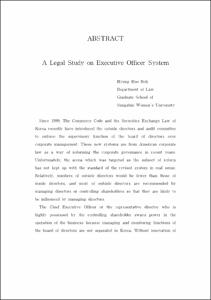
이에 본 논문은 우리나라 주식회사를 대상으로 논의되어 온 기업지배구조와 관련한 이사회의 기능과 이사회 제도의 운영상의 문제점을 살펴보고 이를 바탕으로 집행임원제도에 관한 상법개정안을 검토한다.|Since 1999, The Commerce Code and the Securities Exchange Law of Korea recently have introduced the outside directors and audit committee to enforce the supervisory function of the board of directors over corporate management. These new systems are from American corporate law as a way of reforming the corporate governance in recent years. Unfortunately, the arena which was targeted as the subject of reform has not kept up with the standard of the revised system in real sense. Relatively, numbers of outside directors would be fewer than those of inside directors, and most of outside directors are recommended by managing directors or controlling shareholders so that they are likely to be influenced by managing directors.
The Chief Executive Officer or the representative director who is highly possessed by the controlling shareholder sways power in the operation of the business because managing and monitoring functions of the board of directors are not separated in Korea. Without innovation of the corporate governance, the outside director system seem to end in failure. Moreover, in order to make the numbers of outside directors the smallest, many corporations minimized all the numbers of directors who had to be registered. Instead they have been utilizing unregistered executive officers, which are not provided for in the law. As a result, although the unregistered executive officer does important business, he does not take any responsibility in making misjudgement, since he does not hold the position of director.
In this circumstance, Korean government proposed the proposed amendment of Korean Commercial Code to The National Assembly of Republic of Korea in 2007. This proposed amendemnt includes a proposal for introducing the executive officer system into Commercial Code. The monitoring functions and the management functions become separated by executive officer system, and it is expected to enforce the overseeing function of the board of direcotrs.
The purpose of this study is to analyze issues on Executive Officer System of the amendment draft of Commercial Code which is proposed by Ministry of Justice. First, it deals with Corporate governance and the function of the board of directors, then has a glimpse on Executive Officer System in America and Japan below.
- Issued Date
- 2009
- Awarded Date
- 2009-02
- Type
- Dissertation
- Alternative Author(s)
- Roh, Hyung Hoo
- Affiliation
- 성신여자대학교 대학원
- Department
- 일반대학원 법학과
- Advisor
- 노일석
- Table Of Contents
- 제1장 서론 = 1
제1절 연구의 목적 = 1
제2절 연구방법 및 범위 = 3
제2장 기업지배구조와 이사회 기능 = 5
제1절 서설 = 5
제2절 기업지배구조 = 6
제3절 이사회의 구조와 기능 = 8
Ⅰ. 이사회의 구조 = 8
1. 일원적 제도 = 8
2. 이원적 제도 = 9
3. 우리나라 주식회사 이사회의 구조 = 10
Ⅱ. 이사회의 기능 = 11
1. 경영감시이론 = 11
(1) 反경영자헤게모니 이론(Contra-ManagerialHegemonyTheory) = 11
(2) 反경영자헤게모니 이론(Contra-ManagerialHegemonyTheory) = 11
2. 관계이론 및 권한연합이론 = 12
3. 이사회 기능의 상충과 새로운 견해 = 13
(1) 이사회 기능의 상충 = 13
(2) 새로운 견해 = 14
제4절 이사회제도의 문제점 = 17
Ⅰ. 소유와 경영의 분리 = 17
Ⅱ. 이사회의 감독기능 부실의 문제 = 19
Ⅲ. 엔론사태 이후의 기업지배구조 개혁 = 20
Ⅳ. 현행 이사회 제도의 운영상 문제점 = 21
제3장 주요 외국의 집행임원제도 = 24
제1절 서설 = 24
제2절 미국 = 24
Ⅰ. 집행임원의 개념 = 25
Ⅱ. 집행임원의 지위 = 27
Ⅲ. 집행임원의 선임과 해임 = 28
1. 선임 = 28
2. 해임 = 30
Ⅳ. 집행임원의 권한 = 31
1. 명시적·묵시적 권한 = 31
2. 표현적 권한 = 32
3. 추인 = 33
4. 사실상 임원(de facto officer)의 권한 = 33
Ⅴ. 집행임원의 의무와 책임 = 34
1. 신인의무 = 34
(1) 주의의무 = 36
(2) 충실의무 = 37
(3) 경영판단원칙 = 39
2. 보고의무 = 40
3. 집행임원의 책임 = 40
제3절 영국 = 42
Ⅰ. 영국의 기업지배구조 = 42
Ⅱ. 이사회 구성과 이사의 역할 = 42
Ⅲ. 주요 임원 = 44
1. 집행임원 = 44
2. 총무담당임원 = 45
제4절 일본 = 46
Ⅰ. 집행역제도의 도입배경 = 46
Ⅱ. 집행역의 의의 및 지위 = 51
1. 집행역의 의의 = 51
2. 집행역의 지위 = 52
Ⅲ. 집행역의 선임과 해임 = 53
1. 집행역의 자격 = 53
2. 집행역의 수와 임기 = 54
3. 집행임원의 선임과 해임 = 54
4. 직무집행정지·직무대행자 = 55
Ⅳ. 집행임원의 권한 = 55
1. 일반 = 55
2. 이사회가 집행역에게 결정을 위임할 수 있는 사항 = 56
3. 대표집행역 = 57
Ⅴ.집행역의 의무와 책임 = 57
1. 선관주의의무·충실의무 = 57
2. 경업·이익상반거래 = 58
3. 보수 = 58
4. 책임 = 58
(1) 회사에 대한 책임 = 58
(2) 집행역의 위법행위유지청구권 = 60
(3) 집행역의 제3자에 대한 책임 = 60
제4장 우리나라의 집행임원제도 = 61
제1절 서설 = 61
제2절 우리나라 비등기 집행임원 운용현황 = 62
Ⅰ. 집행임원의 이용실태 = 62
1. 집행임원의 의의 = 62
2. 등기 및 집행임원 현황 = 65
3. 업종별 등기임원 현황 = 66
4. 업종별 임원 현황 = 67
5. 직위별 분포 = 69
Ⅱ. 집행임원 관련판례 = 70
Ⅲ. 실무상 집행임원 이용의 문제 = 72
제3절 집행임원제도의 도입 = 74
Ⅰ. 서설 = 74
Ⅱ. 집행임원제도의 도입논의 = 76
1. 도입의 필요성 = 76
(1) 이사회 감독기능 강화 = 76
(2) 실무상 비등기 집행임원의 법제화 = 78
(3) 세계적 기준(Global Standard) = 79
2. 도입에 대한 비판 = 80
(1) 집행임원제도에 대한 비판적 입장 = 80
(2) 집행임원제도에 대한 반대 근거 = 82
Ⅲ. 소결 = 86
제4절 상법개정안의 집행임원제도 = 89
Ⅰ. 서설 = 89
Ⅱ. 상법개정안에 대한 검토 = 90
1. 집행임원제도 도입방식 = 90
2. 집행임원의 지위 = 92
3. 집행임원의 선임과 해임 = 95
(1) 집행임원의 선임 = 95
(2) 집행임원의 해임 = 96
4. 집행임원의 임기와 보수 = 97
(1) 집행임원의 임기 = 97
(2) 집행임원의 보수 = 98
5. 집행임원의 권한과 책임 = 99
(1) 집행임원의 권한 = 99
(2) 집행임원의 의무와 책임 = 101
6. 대표집행임원과 이사회의장 겸직여부 = 104
Ⅲ. 소결 = 105
제5장 결론 = 107
참고문헌 = 110
ABSTRACT = 118
부록 = 120
- Degree
- Master
- Publisher
- 성신여자대학교 대학원
- 파일 목록
-
-
Download
 집행임원제도에 관한 법적 연구.pdf
기타 데이터 / 110.04 kB / Adobe PDF
집행임원제도에 관한 법적 연구.pdf
기타 데이터 / 110.04 kB / Adobe PDF
-
Items in Repository are protected by copyright, with all rights reserved, unless otherwise indicated.