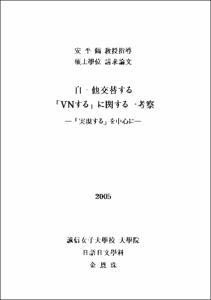
自·他交替する「VNする」に관する一考察 : 「실現する」を中心に = (The) Study of the Transitivity Alternation in 'VN(Verbal Noun)suru' : With focus on jitsugen-suru
- Abstract
- 영문초록: p. [58-60]|現代 日本語의 自動詞와 他動詞는 一般的으로 共通의 語根에서 派生되어,形態的인 對立을 이루고 있다. (「割る·割れる」「起きる·起こす」等).그러나 形態的으로 自動詞와 他動詞가 同一한 경우도 存在한다. (「開く」「增す」「實現する」等)
本稿는 自動詞와 他動詞가 同一한 形態의 動詞들 중에서, 自·他交替하는 二字漢語動詞「VN(Verbal Noun)する」를 對象으로, 그 중「實現する」를 中心으로 硏究하는데 그 目的이 있다. 「實現する」와 같은 二字漢語動詞의 自·他交替 現象을 本稿에서는 自動詞의 主語와 他動詞의 主語가 같은 格을 附與받고 他動詞의 目的語가 다른 格을 附與받는 對格言語에서의 能格性(自動詞의 主語와 他動詞의 目的語가 같은 格을 附與받고 他動詞의 主語가 다른 格을 받는 能格言語의 特徵을 統語的, 意味的으로 擴大시킨 槪念)으로 理解하고자 한다. 先行硏究에서도 「對格言語」에 있어서의 「能格性」 및 「能格言語」에서의 「對格性」을 言及하면서,「對格性」과 「能格性」이 二分되는 槪念이 아니라, 程度의 槪念으로 把握되어야 함이 主張되고 있다.
또한, 本稿에서는 『朝日新聞』과 『日本經濟新聞』 및 文學作品 안에서 「實現する」의 實例를 들어, 「實現する」構文의 「自動詞와 他動詞」 및 「自動詞와 受動形」「他動詞와 使役形」이 서로 對應하는 現象에 對해 考察, 分析해 보았다. 考察의 結果, 形態的으로 對立이 없이 自·他交替하는 現象의 出現에 對해서는 上述한 바와 같이, 對格言語에서의 能格性의 發顯과 關聯이 있다고 主張하였다. 自·他交替 現象과 能格性을 關聯시킨 先行硏究로써 影山(1996)(2001)과 高光柱(2001)를 들 수 있는데, 影山(1996)(2001)에서는 自·他의 形態的인 對立이 있는 動詞까지 能格性으로 다루고 있는데 비해, 本稿에서는 高?췽?(2001)과 같은 立場에서 形態的인 對立이 없는 動詞에 限해서 能格性을 關聯시키고자 한다.
아울러,「實現する」가 自·他交替를 成立하기 위해서는, 他動詞로부터 自動詞로의 派生, 즉 反使役化라는 統語的인 成立條件과 그 對象句에 [+自力性]이라는 意味的인 成立條件이 必要하다는 것을 考察을 通해 밝혔다.
또한,「~を實現する」와「~を實現させる」의 例文分析과 「~が實現する」와「~が實現される」의 例文分析을 檢討한 結果, 바꾸어 使用되어도 意味的인 差異가 보이지 않고 거의 같은 뜻을 나타내고 있다는 것을 確認 할 수 있다. 즉, 「~を實現する」의 異形態로서「~を實現させる」를, 「~が實現する」의 異形態로서「~が實現される」를 抽出할 수 있다. 그러나 「~を實現させる」와 「~が實現される」의 文章을 構成하는 對象句가 人爲的인 行爲를 前提로 하는 경우, 또 意志를 갖는 動作主가 文章에 나타나는 경우는 自·他對應이 되지 않는 制限이 있으며, 이러한 경우에는 바꾸어 使用될 수 없다는 事實도 指摘하였다.
以上과 같이, 本稿에서 自·他交替하는「實現する」構文에 대하여 多角度로 考察을 해 보았다. 이러한 自·他交替의 現象은 對格言語인 日本語에서의 能格性의 發顯이며, 이러한 現象이 나타나기 위해서는 反使役化와 [+自力性]이 必要함을 알 수 있었다. 그리고 自·他對應의 側面에서 使役形을 他動形의 異形態로, 受動形을 自動形의 異形態로 볼 수 있다는 結論을 얻을 수 있었다.|In modern Japanese language, it is generally believed that intransitive and transitive verbs are delivered from the same word root. However these two verbs are contradict each other in terms of the forms in Japanese language(waru(割る):wareru(割れる), okiru(起きる):okosu(起こす) etc.) However in some case the form of two verbs are the same.((aku(開く), masu(增す), jitsugen-suru(實現する))
The purpose of the study is to investigate the transitivity alternation of two verbs between intransitive and transitive verbs in terms of the formation point of view in Japanese language.
I am going to have a case study of the word phrase 'jitsugen-suru(實現する) 'in the transivity alternation of 'Verbal Noun-suru(VNする)'. In my study, I have found that the subject of the two kinds of verbs sometimes endows the same case in the sentence and the object of the transitive verb is endowed the case according to the function of verbs in the sentence.
The previous studies on the subject were told that Ergativity and Accusativity in Japanse language are not the concept of two parts apart and they should be compared in the context only by the degree.
In the study, I have used several cases of the articles on the phrase of 'jitsugen-suru(實現する)' in the articles in 'Ashai Shimbun' and 'Nihon keizai Shimbun'. Through these study, I have analysed the structure of the sentence in the aspects of intransitive and transitive verbs, intransitive verbs and passive voices and transitive verbs and delexical verbs.
I have found that there are relationship between accusative language and ergativity of the language. There were several previous studies in this field by Kageyama(1996, 2001) and Ko Kwangju(2001), Kageyama insisted that the transitivity alternation of verbs which contradict in terms of formation should consider the ergativity of those verbs.
However in my study, I have to follow with Ko Kwangju's point of view and I would like to relate to the verbs of ergativity which are not contradict to the forms of the verbs. If we want to establish the transitivity alternation in 'jitsugen-suru(實現する)', we need to have an anti-causativization from transitive verb to intransitive verb and in the due process the object phrase needs self-imposed meaning in the sentence. I have proved the above point in my study.
I also have analysed through two phrases [~o jitsugen-suru(~を實現する)] and [~o jitsugen-saseru(~を實現させる)] and another two phrases [~ga jitsugen-suru(~が實現する)] and [~ga jitsugen-sareru(~が實現される)] and I have found that there are no difference in the meaning of the verbs. We can get from the different form of [~o jitsugen-suru(~を實現する)] to [~o jitsugen-saseru(~を實現させる)] and the from different form of [~ga jitsugen-suru(~が實現する)] to[~ga jitsugen-sareru(~が實現される)].
However I have found that there are restriction in this methodology, we cannot use this methodology in the case that the phrase in the sentence needs someone who performs the artificial action and the actor who has the will in the sentence. In these cases we can use in alternation.
In my study I have tried to prove that Japanese which is an accusative language has a transitivity alternation which is based on the ergativity of the language. In the process of this phenomena, we need the anti-causativization and self-imposed process in the language. I have also found that in the aspect of transitivity alternation we can make a change from delexical verbs to transitive verbs and from passive voice to intransitive verbs.
- Issued Date
- 2004
- Type
- Dissertation
- Affiliation
- 성신여자대학교 대학원
- Department
- 일어일문학과
- Description
- 국문요약: p. ⅰ-ⅱ
- Table Of Contents
- 論文槪要 = ⅰ
目次 = ⅲ
Ⅰ. 序論 = 1
1. 硏究の目的 = 2
2. 先行硏究と問題提示 = 5
3. 硏究の方法 = 16
Ⅱ. 本論 = 19
1. 「VN(Verbal Noun)する」 = 20
1.1. 「VNする」の構文的特徵 = 20
1.1.1. きまぎまな「する」 = 20
1.2. 「VNする」動詞のタイア = 21
1.2.1. 自 · 他交替する「VNする」 = 21
2. 「實現する」構文における自· 他交替の現象 = 25
2.1. 自 · 他交替する 「實現する」と能格性の關連 = 25
2.1.1. 能格性とは = 25
2.1.2. 能格性の現われ方 = 31
2.2. 自 · 他交替現象と能格性の關連について = 34
2.2.1. 影山(1996)(2001) = 34
2.2.2. 高光柱(2001) = 37
3. 資料分析 = 38
3.1. 「~が實現する」と「~を實現する」の交替 = 38
3.1.1. 統語的な成立條件 = 41
3.1.2. 意味的な成立條件 = 42
3.2. 「實現する」と「實現する」と「實現される」 = 44
3.2.1. 「~が實現する」と「~を實現させる」 = 45
3.2.2. 「~を實現する」と「~を實現させる」 = 46
3.2.3. 「~を實現する」と「~を實現させる」の制約 = 48
3.2.4. 「~が實現する」と「~が實現させる」 = 49
3.2.5. 「~が實現する」と「~が實現させる」の制約 = 50
3.3. 3節のまとめ = 50
Ⅲ. 結論 = 52
參考文獻 = 55
ABSTRACT = 58
附錄 = 61
- Degree
- Master
- Publisher
- 誠信女子大學校 大學院
- 파일 목록
-
-
Download
 自·他交替する「VNする」に관する一考察 : 「실現する」を中心に = (The) Study of the Transitivity Alternation in 'VN(Verbal Noun)s.pdf
기타 데이터 / 4.98 MB / Adobe PDF
自·他交替する「VNする」に관する一考察 : 「실現する」を中心に = (The) Study of the Transitivity Alternation in 'VN(Verbal Noun)s.pdf
기타 데이터 / 4.98 MB / Adobe PDF
-
Items in Repository are protected by copyright, with all rights reserved, unless otherwise indicated.