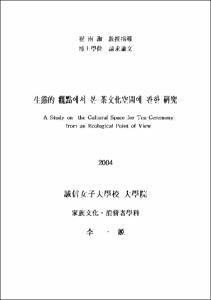
生態的 觀點에서 본 茶文化空間에 관한 硏究
- Alternative Title
- (A) Study on the Cultural Space for Tea Ceremony from an Ecological Point of View
- Abstract
- 차문화공간은 생활철학을 담는 그릇이다. 생활 철학은 한 국가의 역사성을 배경으로 도덕, 종교, 학예와 같은 정신적 문화와 조화된다. 우리 선조들은 사문철(史文哲)의 형이상학적 정신?? 함양하는 차생활을 영위해왔다. 고조선 시대에는 자연숭배를 기본으로 하는 신선사상이 있었으며 삼국시대와 고려시대에는 불교사상이 전성기를 이루었고 조선시대에는 유교를 국시로 삼았다. 아울러 전 시대에 걸쳐 자연 친화적인 생태미를 생활공간에 활용하였으며 자연을 즐기는 풍류정신이 있었다. 이러한 한국의 형이상학적 정신 구현의 장소인 차문화공간은 산과 들, 냇가, 바닷가, 바위, 수목 등 자연적 경관과 정원을 비롯한 연못, 정자, 누각 등의 인공적 공간에서 자율을 기본으로 가변적 차문화공간을 이루어왔다.
한편, 오늘날 산업의 발달로 인한 환경오염은 생태계를 위협하고 있다. 우리가 이런 시점에서 차 한잔을 마시며 삶의 여유를 가져보는 것은 삶의 새로움을 창조할 수 있는 동기를 부여할 수 있다고 본다. 새로운 삶의 창조란 환경의 중요성과 문화의 가치성을 접목시킨 격조있는 생활을 할 수 있는 공간의 활용을 의미한다. 우리 선조들은 자연 속에서 자연과 더불어 공생할 수 있는 정신적 여유를 생태적 주거공간에서 확보하였으며, 선조들의 주생활문화 속에서의 차문화공간을 통하여 온고지신(溫故知新)의 지혜를 받아 왔다. 이에 본 연구는 환경과 문화를 중요시하는 이상적인 차문화공간을 만들어보고자 문헌고찰과 현지답사, 박물관견학 등을 통하여 다음과 같이 연구하였다.
첫째, 고조선부터 현대까지의 차문화와 차문화공간의 특징을 살펴보았고, 중국과 일본의 차문화 및 차문화공간과 연계하여 동양 삼국의 차문화공간의 특징을 살펴보았다.
둘째, 한국의 차문화공간을 구성하고 있는 물질적 요소(축조물, 차도구,조형적 소품)와 정신적 요소(차의 정신)에 대해 살펴보았다.
셋째, 생태적 차문화공간의 개념과 Morrison의 인간생태학모델(Human Ecosystem Model) 간의 연계성에 대해 살펴보았고, 생태계와 차문화공간의 조화, 차문화 공간에 차가 환경에 미치는 영향에 대하여 살펴보았다. 차에는 건강을 이롭게 하는 여러 가지 성분과 환경오염을 예방하고 환경을 정화시키는 요소가 들어있으므로 차의 기능과 생리작용 등 환경과의 연관성을 아울러 살펴보았다.
넷째, 고려시대 다시(茶詩)에 나타난 차문화공간과 조선시대 다화(茶畵)에 나타난 차문화공간, 조선시대 지식인의 차문화공간의 지역별 사례, 근대 차인들의 차문화공간을 살펴보았다. 현대 차문화공간의 사례를 공동주택과 단독주택으로 구분하여 살펴보았으며 현대 차문화공간에 자연친화적?見? 환경보전적인 생태적 공간으로서의 차문화공간을 적용한 생태적 차문화공간 활용에 대해 살펴보았다. 또한 이에 대한 문제점 및 개선방안을 모색하여 이상적인 생태적 차문화공간을 계획해 보았다.
연구의 실효성을 위하여 국내외의 문헌고찰과 박물관 견학, 그리고 현지 답사와 현대의 주거공간 방문 등의 방법을 통하여 본 연구를 시도하였다. 연구결과, 우리나라의 차문화공간은 고조선 시대의 신선사상, 삼국시대와 고려시대의 불교사상, 조선시대의 유교사상의 영향을 받았으며 전 시대를 거쳐 자연을 즐기는 풍류정신이 있었고 자연 친화적인 생태미를 주거공간과 생활에 활용하였다는 것을 알 수 있었다. 이러한 한국의 형이상학적 정신 구현의 장소로서 차문화공간은 산과 들, 냇가, 바닷가, 바위, 수목 등 자연적 경관과 정원을 비롯한 연못, 정자, 누각 등의 인공적 공간에서 자율을 기본으로 가변적 차문화공간을 이루어 왔다.
이와 같이 선조들은 자신의 종교와 철학을 바탕으로 어떤 한 물질에 얽매여 틀을 정하고 구속받지 않았음을 알 수 있었다. 따라서 현대 차문화공간은 어떤 형태로 따로 규격화 되는 것이 아니라 선조들과 같이 자연친화적인 차문화공간으로서 자신의 철학(???)이 숨쉬는 의미체계(意味體系)로서의 차문화공간의 창출을 모색하여야 하며 생태적 차문화공간은 그러한 차정신을 구현하되 현실여건에 맞게 창조되어야 할 것이다.
앞으로의 세계문화는 형이상학적 정신세계를 중요시하는 동양적문화가 주도하게 될 것이며 그 중에서도 국적, 인종, 종교, 사상을 초월하여 누구나 공감할 수 있는 차문화가 중요한 위치를 차지하게 될 것이라고 생각된다. 따라서 우리가 영위하고 있는 실내외의 공간에서 차생활을 생활화하려는 차문화공간은 이러한 의도를 성공적으로 이루게 하는 근본적인 방안이라고 생각한다. 자연환경과 인공환경, 인간행동환경이 접목된 총체적 공간으로서의 생태적 차문화공간을 모색하는 것은 사회의 병리 현상을 치유하고 우리의 삶의 질을 높이며 정신문화를 승화시키는 데 중요한 역할을 할 것이라고 생각한다.|Tea culture space is the space that reflects philosophy of life. The philosophy of life is harmonized with mental culture such as morality, religion or art, which is based on a nation's history. Our ancestors had developed their tea life, including metaphysical spirit of history, literature, and philosophy: nature worshipping in the ancient times, Buddhism in the three kingdoms and Koryo period and confusianism in Chosun Dynasty. In addition, there was what is called "Pungryu", an elegant thought, applying nature-friendly beauty to their life style and enjoying nature itself. Such tea culture space in Korea, the place that accomplishes metaphysical spirit, has been formed with a variability of natural environment such as mountain, sea, rock, and trees as well as artificial environment such as pond and pavilion.
Meanwhile, the development of industrialization and technology resulted in environmental pollution that has been threatening ecosystem over time. Thus, a peaceful and quiet space for having a cup of tea in everyday life as a part of our life is needed. From our ancestors, we should learn recreation of the sophisticated space free from the pollution and turbulence where our ancestors had enjoyed peaceful life over a cup of tea. In positive of the unique traditions related to tea culture in Korea, this thesis attempted to generate ideal tea culture space that connects environment and culture. Therefore, this thesis examines:
First, history of tea and the characteristics of tea culture space from Gochosun to modern times was reviewed and characteristics of cultural history of tea and tea culture space in China and Japan were analyzed to compare the characteristics of tea culture space of the three nations.
Second, physical factors (builidings and ornaments) and psychological factors (spirit of tea) of Korean tea culture space were reviewed.
Third, the connection between the concept of tea culture space and Human Ecosystem Model by Morrison was analyzed. Also, this thesis examined how the ingredients of tea affect the culture of ecosystem and why tea culture space is needed. The relationship between environment and physiological function were also examined because tea includes varieties of ingredients for promoting health and protecting environmental pollution.
Finally, tea culture spaces were reviewed over time. Tea culture space on tea related poetry during Koryo age, ecological tea cuture space on tea related pictures and examples of tea culture space by each region during Chosun dynasty, and tea culture space of recent tea users. In order to study tea culture space, complex residential area and single residential areas were compared. The useful of tea culture space as a ecological space was also examined.
To achieve the purpose of this study, related literatures were reviewed, and investigations of museums and a survey on modern living space were also conducted.
The results show that the space of our tea culture were affected by nature worshipping of Gochosun, Buddhism of Koryo, and Confusianism of Chosun with "Pungryu", the idea that enjoys nature, thereby applying environment-friendly ecological beauty to their living space and life. The cultural space in Korea is composed of natural environment such as mountain, sea, rock, or trees and artificial environment such as pond or pavilion.
The research findings indicate that our ancestors were not limited themselves to a certain frame based on their own religion and philosophy. Therefore, today's tea culture space should be created as nature-friendly and realistic environment, including an individual's own philosophy, not limited to any standardized type of space.
In the future, oriental culture with metaphysical value will lead the world culture, and especially, tea culture would play an important role regardless of nationality, race, religion, and ideology. Therefore, establishing a tea culture space in a living space would be the fundamental methods that would be able to settle down such tea life into our daily life. Our attempts to create ecological tea culture space as a integrated cultural space of natural, artificial, and human behavioral environment will contribute to enhance our quality of life.
- Issued Date
- 2004
- Type
- Dissertation
- Affiliation
- 성신여자대학교 대학원
- Department
- 가족문화소비자학과
- Description
- 국문요약: p. i-ⅲ
- Table Of Contents
- 論文槪要 = ⅰ
目次 = ⅳ
Ⅰ. 서론 = 1
1. 연구의 의의 = 1
2. 연구내용 = 3
1) 연구목적 = 3
2) 연구방법 = 4
3. 연구의 과정 = 5
Ⅱ. 차문화공간에 대한 역사적 고찰 = 6
1. 한국의 시대별 차문화공간 = 6
1) 고조선 시대(B.C. 2333~B.C. 108) = 6
2) 가야 시대(B.C. 42-A.D. 562) = 9
3) 삼국시대 = 10
4) 고려 시대(918-1392) = 20
5) 조선 시대(1392-1910) = 30
2. 한국 · 중국 · 일본의 차문화공간 = 45
1) 한국(韓國) = 45
2) 중국(中國) = 49
3) 일본(日本) = 66
4) 한 · 중 · 일(韓 · 中 · 日)의 차문화 및 차문화공간의 특징비교 = 84
Ⅲ. 차문화공간의 구성요소 = 86
1. 차문화공간과 연관된 축조물(築造物) = 86
1) 단(壇)과 대(臺) = 87
2) 정원 건축물(庭苑 建築物) = 88
2. 차문화공간의 조형적 소품 = 91
1) 차도구(茶道具) = 91
2) 장식적 소품 = 99
3. 차문화공간과 차(茶)의 정신(精神) = 102
Ⅵ. 생태적 관점에서 본 차문화공간 = 106
1. 생태적 차문화공간의 개념 = 106
2. 생태계와 차문화공간의 조화 = 109
3. 차문화공간에서 차가 환경에 미치는 영향 = 111
1) 차의 색(色) = 111
2) 차의 향(香) = 114
3) 차의 맛(味) = 116
4) 차의 수성(水聲) = 118
5) 차와 중금속(重金屬) = 118
6) 차와 생리작용(生理作用) = 120
7) 차와 생활용품(生活用品) = 122
Ⅴ. 생태적 차문화공간의 사례분석과 활용계획 = 125
1. 생태적 차문화공간의 사례분석 = 125
1) 고려시대 다시(茶詩)에 나타난 차문화공간 = 125
2) 조선시대 다화(茶畵)에 나타난 차문화공간 = 135
3) 조선시대 지식인의 차문화공간 = 144
(1) 중부권(서울, 경기, 강원지역) = 144
(2) 충청권(충청지역) = 148
(3) 동남권(영남지역) = 152
(4) 서남권(호남지역) = 153
(5) 제주권(제주지역) = 158
4) 근대 차인의 차문화공간 = 160
2. 현대 차문화공간 = 171
1) 공동주택 = 173
2) 단독주택 = 178
3) 현대 차문화공간의 사례분석 = 183
3. 생태적 차문화공간으로서의 현대 차문화공간 = 185
1) 자연공간 = 186
2) 인공 공간 = 186
3) 인간행동 공간 = 190
4) 이상적인 생태적 차문화공간 활용계획 = 192
Ⅵ. 결론 = 196
參考文獻 = 203
ABSTRACT = 211
- Degree
- Doctor
- Publisher
- 誠信女子大學校 大學院
- 파일 목록
-
-
Download
 生態的 觀點에서 본 茶文化空間에 관한 硏究.pdf
기타 데이터 / 53.4 MB / Adobe PDF
生態的 觀點에서 본 茶文化空間에 관한 硏究.pdf
기타 데이터 / 53.4 MB / Adobe PDF
-
Items in Repository are protected by copyright, with all rights reserved, unless otherwise indicated.