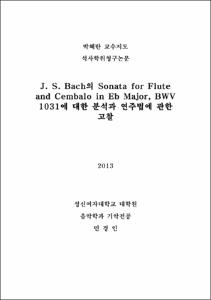
J. S. Bach의 Sonata for Flute and Cembalo in Eb Major, BWV 1031에 대한 분석과 연주법에 관한 고찰
- Abstract
- 논문개요
중부 독일의 아이제나흐(Eisenach)에서 태어난 요한 제바스티안 바흐(Johann Sebastian Bach, 1865-1750)는 그가 살아있을 때보다 후대로 내려올수록 그 영향이 커지기 시작하여, 19세기 이후부터 본격적으로 그의 음악이 연구되고 연주되기 시작하였다. 바흐는 기존의 대위법 스타일을 당시 유행하던 새로운 화성 어법과 융합하여 일찍이 없었던 표현력에 도달하였고, 대위법, 선율, 리듬, 화성 모두 최고라고 인정하지 않을 수 없을 정도로 그의 많은 음악들은 매우 뛰어났다. 그의 생애는 성장 과정을 지난 1702년 이후 1703~1708년의 아른슈타트-뮐하우젠 시기, 1708-1717년의 바이마르 시기, 1717~1723년의 쾨텐 시기, 그리고 1723~1750년의 라이프치히 시기로 나누어 볼 수 있다.
바흐는 이 중 쾨텐에서 궁정 악장으로 지내면서 세속적인 기악곡과 창작 활동을 많이 했던 1717~1730년에 플루트를 위한 소나타를 여러 곡 작곡하였으며, 그 중 본 논문에서 분석할 악곡은 in Eb Major, BWV 1031이다. 본 논문은 이 곡을 바로크 스타일에 맞는 연주 방법에 대한 연구를 목적으로 한다.
바흐의 Sonata for Flute and Cembalo in Eb Major, BWV 1031은 3개의 악장으로 구성되어 있으며, 1악장은 2부 형식으로서 빠른 템포로 연주되고, 2악장은 3부 형식으로서 느리게 연주되며, 조성은 딸림조의 나란한조 G minor으로서 Siciliano라는 부제가 붙어 있다. 3악장은 다시 원조(Eb Major)로 돌아오고 2부 형식으로 구성되어 있으며 빠르게 연주된다. 악보에 셈여림 혹은 아티큘레이션 등의 표시가 없기 때문에, 연주자는 악곡의 흐름에 관한 정확한 분석과 연주 기법에 관한 자료를 토대로 셈여림의 정도, 레가토(legato)로 연주할 것인지의 여부, 레가토로 연주할 경우 그 범위, 숨을 쉬는 위치 등을 판단하여야 한다. 이 악곡에서는 보통 2마디, 4마디, 8마디 단위로 레가토를 이루고 있으며, 16분음표 위주로 되어 있거나 서정적인 분위기를 만들 때에는 레가토 위주로, 8분음표 혹은 그 이상 길이일 경우 레가토로 연주하지 않는 경향이 있다. 셈여림의 경우 높은 음역 혹은 상행은 forte로, 낮은 음역 혹은 하행은 piano로 연주되며, 프레이즈의 반복이 있을 경우 처음에는 forte로, 다음에는 piano로 연주한다. 결국 정확한 연주는 악곡의 철저한 분석과 연주 기법에 관한 기존 자료들의 검토로부터 시작된다. 대략 1600년에서 1750년 사에에 작곡된 바로크 음악의 대표적인 특징 네 가지는 그랜드 포지션(Grand position), 대조, 구조적인 것으로부터의 자유로운 연주, 장식음(Ornaments) 등이 있다.
-------------------------------------------------------
1) 바로크(Baroque) 라는 말은 본래 “일그러진 진주”를 뜻한다.
|Abstract
Analysis of J. S. Bach's Sonata for Flute and Cembalo in Eb Major, BWV 1031 and Its Performing Techniques
Min kyungin
Department of Music
Sungshin Women's University
Born in Eisenach, a city of central Germany, Johann Sebastian Bach (1865-1750) was not highly influential during his lifetime, but became widely recognized and studied along after 19th century. His music not only obtained unprecedented expressiveness by integrating conventional counterpoint style with a popular, novel harmonic organization of that time, but also undoubtedly showed excellence in counterpoint, melody, rhythm, and harmony. His life after the childhood years up until 1702 is divided into four periods: Arnstadt-Muelhausen period(1703 - 1708), Weimar period (1708 - 1717), Koethen period (1717 - 1723), and Leipzig period (1723 - 1750).
While serving as a director of music in the court of Koethen from 1717 to 1730, Bach was prolific with secular instrumentals and various compositions, and wrote many Sonatas for flute. This paper analyses Sonata for Flute and Cembalo in Eb Major, BWV 1031, which was written in that period, and aims to utilize the music piece to study performing techniques appropriate for Baroque style.
Sonata for Flute and Cembalo in Eb Major, BWV 1031 falls into 3 movements, with the first movement of binary form opening the song with quick tempo. The second movement of ternary form, subtitled as Siciliano, is played slowly, under the relative key of the dominant key, G minor. Tonality changes to the original key (Eb Major) in the third movement, which is played quickly in binary form. Since the score of the music is not manifested with dynamic marks or articulations, performing artists should determine the degree of the dynamics, the usage and the scope of legato, the spot of rest, and such based on precise analyses of the music and the performing techniques. Most legatos found in this music piece are stretched in 2, 4, or 8 measures, and they tend to appear where sixteenth notes are dominant, or where the mood grows lyrical, while they tend to disappear where measures are composed of eigth or longer notes. In terms of dynamic marks, upper or upward register is played forte, and lower or downward register piano, while repetitive phrases are played forte at first but piano at the following. Accurate performance, therefore, begins with keen analysis over previous studies on performing techniques and thorough review of the music. The four distinguished features of Baroque music composed around between 1600 and 1750 are Grand position, contrast, structurally unconstrained performances, and ornaments.
-------------------------------------------------------
1) Baroque originally means 'an imperfect pearl'
- Issued Date
- 2013
- Awarded Date
- 2013-02
- Type
- Dissertation
- 파일 목록
-
-
Download
 J. S. Bach의 Sonata for Flute and Cembalo in Eb Major, BWV 1031에 대한 분석과 연주법에 관한 고찰.pdf
기타 데이터 / 3.36 MB / Adobe PDF
J. S. Bach의 Sonata for Flute and Cembalo in Eb Major, BWV 1031에 대한 분석과 연주법에 관한 고찰.pdf
기타 데이터 / 3.36 MB / Adobe PDF
-
Items in Repository are protected by copyright, with all rights reserved, unless otherwise indicated.